

October 7, 2026 · 6 min read
Wedding Guest List Etiquette: Plus-Ones and Kids
Wedding guest list etiquette made simple: who to cut, how to offer plus-ones fairly, whether to invite kids, and how to word it all.
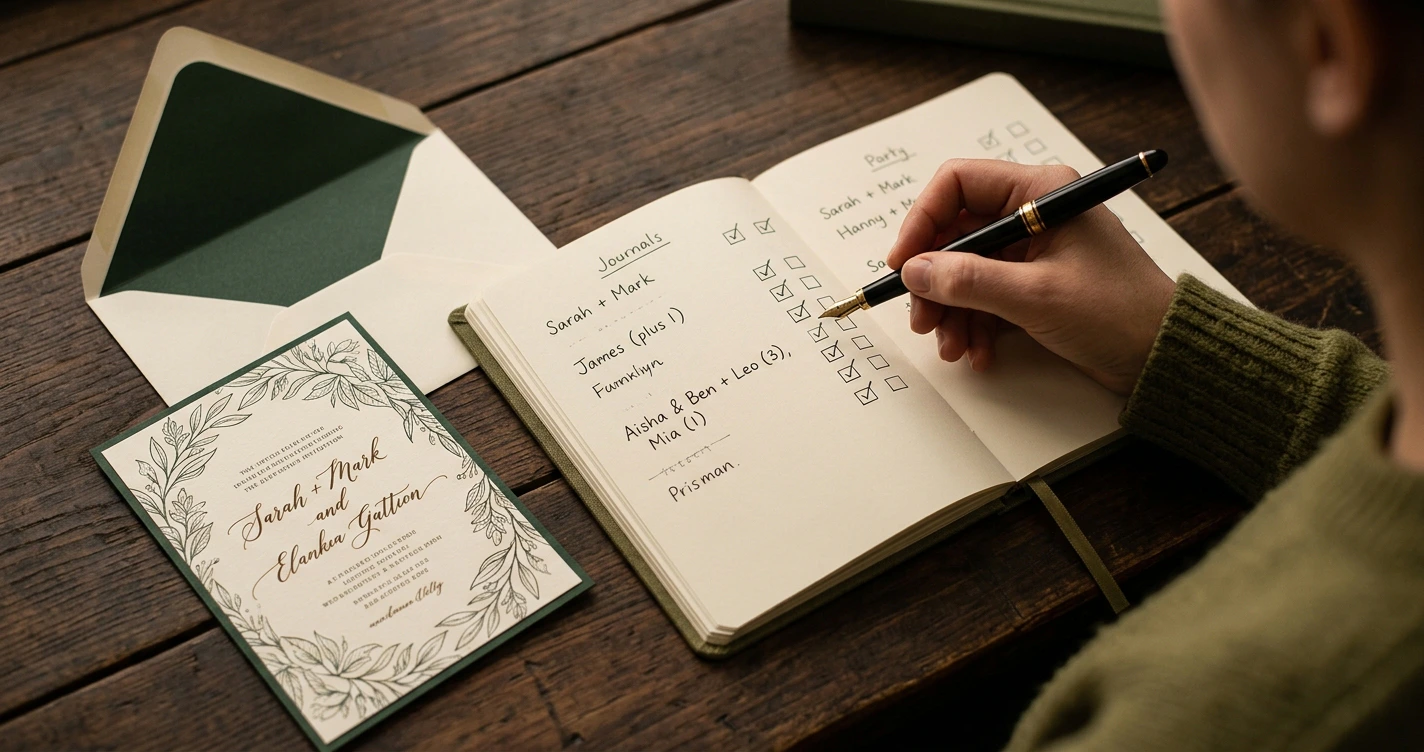
Start with the number your venue and budget can actually hold, then build the list inward from there. Wedding guest list etiquette comes down to applying one fair rule to everyone, communicating your choices early, and writing each invitation so it answers the question of who is invited before anyone has to ask.
That matters because guests are the single biggest driver of what a wedding costs. Couples married recently hosted an average of 117 guests at about $292 per guest, according to The Knot Worldwide's 2026 Real Weddings Study. At that rate, every ten names you add is close to $2,900, so the list is a budget decision as much as a social one. Get the etiquette right and you protect both your spending and your relationships.
Deciding who makes the cut when space is tight
Set your maximum headcount first, then invite in order of closeness, because a hard ceiling makes the hard choices for you. Work in concentric circles: immediate family, then the friends you see regularly, then extended family and colleagues, and finally the nice-to-haves.
A few principles keep this fair and defensible.
- Apply one standard per group. If you invite one first cousin, invite them all. If you include one work friend, decide the rule for the rest of the team rather than choosing name by name.
- Drop the obligation invites you dread. If you have not spoken in years and you would feel relief at a "no," that name belongs lower on the list.
- Keep both partners' sides roughly balanced in principle, even if the raw numbers differ, so neither family feels crowded out.
- Protect a small buffer under your ceiling for the guests you forgot and the family requests you cannot avoid.
If your first count runs long, trimming guests is almost always the fastest way to recover budget, which is also why the cost-per-head figure above is worth revisiting before you finalize anything.
The rules around offering plus-ones fairly
Plus-one etiquette is simpler than it feels once you pick a consistent test and apply it to everyone. The standard most couples use, and the one the Emily Post Institute endorses, is that spouses, fiances, and live-in partners are always invited, while a guest's casual dating partner is optional.
That single line resolves most disputes. A married sibling comes with their spouse. A friend who just started dating does not automatically get a seat for someone you have never met.
For single guests, you have room to be generous or practical:
- Offer plus-ones to the members of a wedding party, since they are giving the most time and will often attend solo otherwise.
- Consider a plus-one for anyone who would otherwise know no one at the reception, so they have a familiar face.
- It is perfectly correct to invite single friends on their own when space is tight, as long as you treat that whole circle the same way.
The quiet key to plus-one etiquette is the invitation itself. Address it to the exact names invited, because an envelope made out to one person is the polite, unmistakable answer that there is no extra seat.
Whether to invite children and how to word it
Decide early, commit fully, and tell parents before the invitations arrive, because childcare takes planning and surprises breed resentment. An all-ages wedding and an adults-only one are both entirely proper. What is not proper is an unclear invitation that leaves families guessing.
Pick one approach and keep it consistent:
- Adults only, no exceptions. The cleanest version to enforce, since you are not drawing a line between whose children count.
- Immediate family children only, such as the couple's own kids, nieces, and nephews. Reasonable, but say so plainly so other parents understand the distinction.
- All children welcome. Lovely, and worth flagging to your caterer and planner so you have appropriate food and space.
Wording carries the message. Address the invitation only to the adults you are inviting, and reinforce it in plain language on your details card or wedding website: "We have chosen to celebrate adults-only and hope this gives you a night off to enjoy with us." The Emily Post guidance is to reach out to families even before invitations go out, so parents have real time to arrange care rather than learning the rule from an envelope.
If a guest replies with children you did not invite, respond directly and warmly. Explain that your venue and budget only allow for the people named, and most parents will accept a space limit far more easily than a judgment call.
Handling A-list and B-list invitations tactfully
A B-list works when it is invisible, so the only rule that matters is timing. Send your A-list invitations early, around eight weeks out, then release B-list invitations as regrets come in. Done quietly, no guest can tell which tier they were on.
Build the tiers before you address a single envelope.
- Group your must-invite guests as the A-list and send theirs first.
- Hold the B-list ready, ranked, so you can send the moment a "no" frees a seat.
- Set an internal cutoff, ideally no later than three to four weeks before the day, and stop sending after it. An invitation that arrives ten days out reads as an afterthought.
Save-the-dates deserve a caution here: only send them to people you are certain will be invited. A save-the-date is a promise, so sending one to a B-list guest removes your flexibility entirely.
Managing family expectations and pressure
Agree on your non-negotiables as a couple first, then present them to family as settled decisions rather than open questions. Most guest list friction starts when parents assume the list is a group project, so the kindest thing you can do is set the frame early.
A calm script helps more than a long debate:
- "We have set our maximum at [number], so we are keeping the list to people we both know well."
- "We would love your list of must-invites, and we will fit as many as we can within that number."
- "We have decided this is an adults-only celebration, and that applies across the board."
When a parent is contributing financially and expects names in return, address it head-on and early. Offer a specific allocation ("we can fit twenty of your guests") so the conversation is about a number, not an endless negotiation. The envelope still protects you later: once invitations are addressed to named guests, you have a courteous, firm answer to any late additions.
Tracking everything cleanly in a guest list tool
The etiquette only holds if the data holds, so keep every tier, plus-one, child, dietary note, and RSVP in one place instead of scattered across texts and spreadsheets. A shared guest list and RSVP app lets you tag A-list and B-list, mark who has a plus-one, flag which households include children, and watch your live headcount against your venue ceiling.
With Wdplan, your guest list, RSVPs, budget, and seating chart live in the same workspace, so a late "no" instantly frees a seat on your B-list and updates your per-head costs at the same time. That single source of truth is what stops the two classic failures: inviting past your limit, and missing someone you meant to include.
Before you address a single envelope, build your list in your tracker with tiers and plus-one rules already set. The etiquette becomes easy to follow when the tool is doing the remembering, and you get to spend your attention on the celebration instead of the arithmetic. Open your guest list, set your ceiling, and let every reply update itself from there.