

October 12, 2026 · 6 min read
How to Track Wedding Expenses Without Losing Your Mind
Learn how to track wedding expenses with a simple system: categorize costs, log deposits, split spending, and catch overspending early.
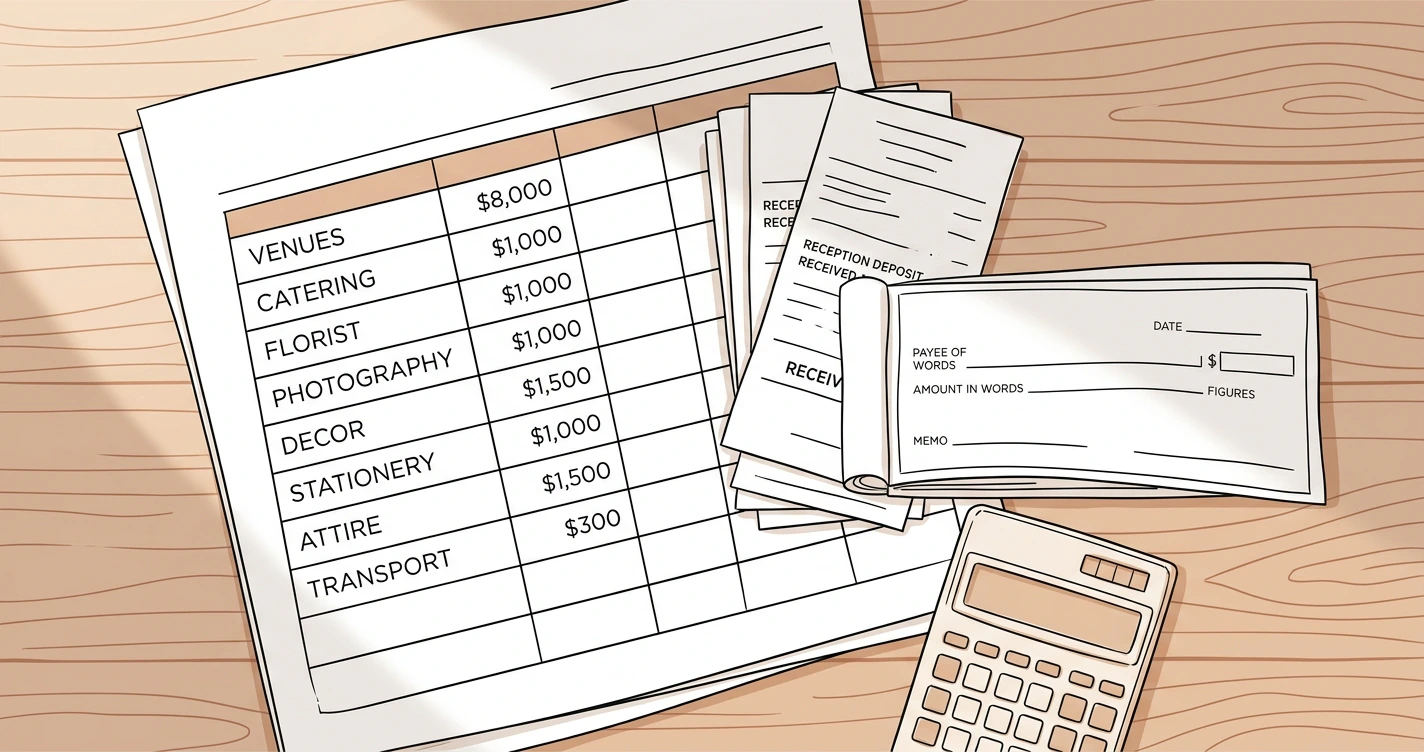
Start by putting every wedding cost in one tracker, because the fastest way to overspend is to carry numbers in your head. If you track wedding expenses in a single place, logging each deposit, balance, and due date as it happens, you always know your real total and what is still owed.
That matters because weddings are expensive and the costs arrive in waves. The average US wedding reached $34,200 in 2025, about $292 per guest for 117 guests, according to The Knot 2026 Real Weddings Study. A number that size does not fit comfortably in your memory, which is exactly why a system beats mental math.
Why a Wedding Budget Tracker Beats Mental Math
A wedding budget tracker wins because it turns a dozen moving numbers into one live total you can trust. Roughly 74% of couples go over budget, and 20% overspend by at least $10,000, according to a Zola survey of more than 6,000 couples (CNBC, 2025). Most of that overspend hides in costs no one wrote down.
Mental math fails for a simple reason: a wedding is dozens of separate purchases spread over months. You remember the venue and forget the alterations, the stamps, the vendor tips, and the extra chairs. Each small gap feels minor on its own, yet together they quietly add thousands to your total.
A tracker fixes this by holding every figure in one view. You see your planned budget, your actual spend, and the difference between them at a glance. When both partners open the same tracker, there is no guessing and no surprise, because the running total is already done for you. Wdplan keeps your budget beside your guest list and tasks, so the number updates as your plans change.
Categorizing Every Cost From Venue to Favors
Group your spending into clear categories first, because categories are what make a large total readable. Venue and catering alone eat the biggest share of most budgets, and at roughly $292 per guest, catering scales directly with your headcount. Sorting costs into buckets shows you where the money actually goes.
Set up your categories before you book anything. A practical starting list covers the parts of almost every celebration:
- Venue and rentals: the space, tables, chairs, linens, and any required insurance.
- Catering and drinks: food, bar, cake, service staff, and gratuities.
- Photography and video: coverage hours, albums, and second shooters.
- Attire and beauty: dresses, suits, alterations, hair, and makeup.
- Flowers and decor: bouquets, centerpieces, lighting, and signage.
- Music and entertainment: band or DJ, ceremony musicians, and sound.
- Stationery: save-the-dates, invitations, stamps, and signage.
- Rings: both bands and any resizing.
- Transport and stays: cars, shuttles, and hotel blocks.
- Small extras: favors, welcome bags, tips, and the day-of emergency kit.
That last category is the one couples skip, and it is where budgets quietly leak. Give favors, tips, and extras their own line so they stop hiding inside other totals. For a deeper walkthrough of trimming each category, see how to plan a wedding on a budget.
Logging Deposits vs Final Balances
Record every deposit and its final balance as two separate line items, because one number cannot tell you both what you paid and what you still owe. A florist might take a 50% deposit at booking and the rest two weeks before the wedding. If you log only the deposit, your tracker understates your real commitment by half.
Treat each vendor as having three figures: the total price, the deposit paid, and the balance remaining. Enter all three. Your tracker then shows a clear picture at any moment: money already spent, money still committed, and money still free to allocate elsewhere.
This split also protects you from a common trap. Seeing a long list of paid deposits can feel like progress, yet the balances due are often larger than the deposits already gone. Keep both columns visible so the balance owed never ambushes you in the final month, when several vendors want their remainder at once.

Spotting Overspending Before It Happens
Catch overspending early by comparing planned versus actual spend after every booking, not at the end. Since 20% of couples overshoot their budget by at least $10,000, per Zola's 2025 survey, the difference between a tight budget and a blown one is usually how early you notice the drift.
Set a planned amount for each category before you shop, then log the real cost as you commit to it. The moment a category runs over, you can see it against the others and decide: absorb it, trim elsewhere, or adjust the plan. A small overage on flowers is easy to offset against music if you spot it in week two rather than month six.
Guest count is your most powerful lever here. At about $292 per guest, every 10 names you add or cut moves your catering and venue cost by roughly $2,900. If a category keeps creeping, revisit the list before you cut the things you care about. Trimming ten guests often rescues a budget faster than downgrading the photographer.
Splitting Costs Between Partners and Families
Agree on who pays for what before you book, then tag each cost to the right contributor so the split stays clear all the way through. Money is one of the most common planning tensions, and it eases considerably when the arrangement is written down rather than assumed in conversation.
Start with a short, direct talk about contributions. Will each family cover specific categories, will everyone pool into one fund, or will you and your partner handle the whole thing yourselves? Whatever you choose, record the agreement, because a vague promise to help is hard to track against real invoices later.
Then tag every line item with its payer. A shared tracker lets both partners and any contributing family see the same figures without a stream of forwarded screenshots. Everyone knows their share, what has been paid, and what is still coming. When the numbers are transparent, the awkward follow-up messages mostly disappear, and the planning stays about the celebration rather than the accounting.

How to Track Wedding Expenses by Receipt and Payment Date
Attach a payment date and a receipt to every expense, because a cost you cannot prove or schedule is a cost that creates problems. Missed final payments risk your bookings, and lost receipts make disputes or refunds far harder to settle when a vendor cancels or a deposit needs returning.
Build a simple due-date habit. For each line item, note the deposit date, the balance due date, and the person responsible for sending it. Review that list weekly in the final two months, when payments cluster. A tracker that surfaces upcoming due dates means you pay on time without a wall of phone reminders.
Keep the paperwork beside the number too. A photo of each receipt, invoice, or contract stored against its line item means everything lives in one trusted place. When a question comes up about what you agreed or what you paid, the answer is a click away rather than buried in an inbox. That single habit saves hours and protects deposits you have already handed over.